bomonike
Skills and certification around the DevOps industrial complex







The red line above shows the desired profile for a Senior DevOps Engineer. Other jobs would have a different profile.
For both the red and blue lines, the further a point is from the center, the more skill is noted:
\1. Novice / 2. Competent / 3. Proficient / 4. Expert / 5. Master
-
Novice represents the beginning stage where someone has little to no experience with a skill or domain. Novices typically rely heavily on rules, guidelines, and step-by-step instructions. They lack the contextual understanding to know when rules should be bent or broken, and they need significant guidance and supervision. Their performance is often rigid and focused on following procedures correctly rather than achieving optimal outcomes.
-
Competent describes someone who has gained enough experience to start making conscious choices about their actions. They can prioritize tasks, plan ahead, and have developed some personal attachment to their outcomes. Competent practitioners can handle routine situations independently but may struggle with unexpected complications. They’re beginning to see patterns and can adapt their approach based on experience, though they still rely on analytical thinking more than intuition.
-
Proficient individuals have developed a more fluid, intuitive grasp of their domain. They can see situations holistically rather than just as a collection of parts, and they recognize patterns quickly. Proficient practitioners know what’s important in various situations and can focus their attention accordingly. They’ve moved beyond rigid rule-following to understanding the deeper principles underlying their field, allowing for more flexible and context-appropriate responses.
-
Expert level represents highly developed intuitive understanding combined with extensive analytical ability when needed. Experts have a vast repertoire of experienced situations to draw from and can quickly identify what’s most relevant in new circumstances. They operate fluidly and efficiently, often making complex decisions that appear effortless to observers. Experts can handle novel situations by drawing analogies to their deep experience base and can often sense when something isn’t right even before they can articulate why.
-
Master goes beyond individual expertise to encompass wisdom, innovation, and the ability to guide others’ development. Masters not only perform at the highest level but can also break new ground in their field, create new methods or understanding, and effectively teach and mentor others. They possess both deep technical knowledge and the broader perspective to see how their domain connects to larger contexts and purposes.
The blue line showing ratings for “Your profile” above is hypothetical.
The gap is the work needed to close the gap.
Our DevOps Skills Radar Chart

Body of Knowledge
- Organizational experience (Etiquette, Events, Presentations, OKRs, Planning, Incident Response)
- Security Habits (Email/Spam, Password managers, signing, 2FA, VPN, privacy)
-
Interpersonal (Calendars, Appointments, Social Networking, shares, GitHub)
- Hardware selection (components, speeds, monitoring)
- Shell automation (Bash, Zsh) to install laptop components (keyboard speed & shortcuts)
- Network & system administration (Permissions)
-
Adaption & creativity (Debugging, Generative AI prompt & context engineering)
- Linux (PATHs, Files, folders, OS flavors)
-
CI/CD (Git, Git Hooks, GitHub Actions, SAST)
- Imperative programming using Python, C, Go, Rust, Ruby (strings, lists, arrays, vectors, matrices)
- Technology integration (testing & debugging using IDEs, logs, metrics, traces)
- Object-oriented programming
- Functional programming
- Optimization (Spreadsheets, Algorithms, CUDA Parallel Computing)
-
Infrastructure (Cloud Terraform, Ansible, alerting)
- DB & Data (shops, transactions, migration)
- Web (JavaScript, HTML, CSS) GUI for dashboards
- Graphics & Motion design (gif, PowerPoint, videos)
Compare and contrast with other frameworks:
- Python coding mind-map
-
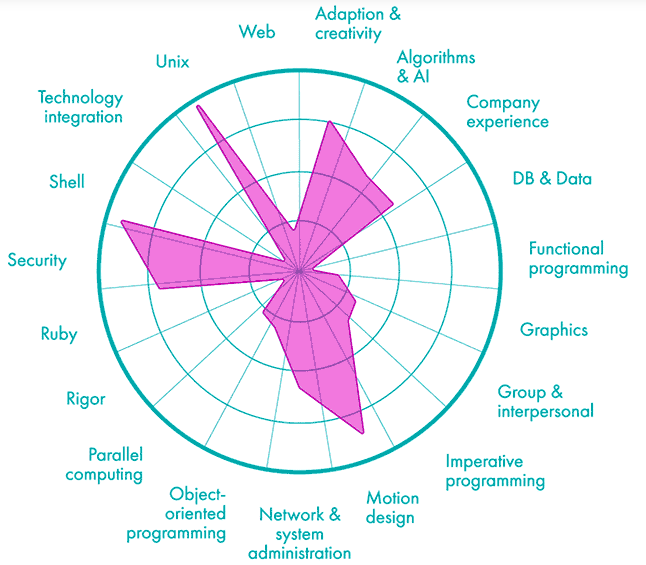
42’s organized what they train developers:
Clockwise from the top:
- Adaption & creativity
- Algorithms & AI
- Company experience
- DB & Data
- Functional programming
- Graphics
- Group & Interpersonal
- Imperative programming
- Linus (Unix)
- Technology integration
- Motion design (3D videos)
- Network & system administration
- Object-oriented programming
- Parallel Computing
- Rigor
- Ruby programming
- Security
- Web (JavaScript, HTML, CSS)
- Shell (Bash, Zsh)
Areas of Skills and Knowledge
Different organizations have organized what “DevOps” professionals need to know and do:

The above is from the 6 principles of DevOps at DASA (DevOps Compentence Association). It has a 24 question QuickScan for individuals to self-assess their own level in each of the 12 (4 skill areas and 8 knowledge areas) in the DevOps Compentence Model, with levels at 1. Novice / 2. Competent / 3. Proficient / 4. Expert / 5. Master.
There are several organizations providing (overlapping) certification exams and training based on DevOps.
To develop and validate those skills, DASA provides 7 exams in their DASA certification scheme implemented by iSQLI (which also handles ISQTB QA, Lean Six Sigma, and other certifications).
PROTIP: Questions in the QuickScan contain statements about what each person can actually do to reach the highest levels in each area (such as being proactive vs. reactive, on a daily basis, inside and outside the organization, etc.). These statements are gold because they make the DevOps journey real. Make an appointment with yourself to review these statements once a week to document proof of how you personally are achieving them.
Business Value Optimization: Use of the IT service in real life, including direct feedback loop of user comments to team, service level management, definition of done, business activity/performance monitoring, business case management:
- I am aware of the organizational goals and objectives and I constantly ensure that requested features align with goals and objectives.
-
I have intimate knowledge. I have proven experience with (supporting) business processses.
Business Analysis: Evangelism, coaching, self-confidence, proactivity, reflection, trust, open discussions, experimentation, fail fast, courage to change:
- I have proven experience of structuring and organizing requirements, using techniques to specify and model requirements and facilitating refinement meetings.
-
I proactively collect feedback and communicate it with the team through a structured method. I have well developed communication, facilitation, and negotiation skills.
Architecture and Design: Ensuring fit between developments and current situation, overall service design, patterns & styles:
- Extensive Knowledge - Within the team, I ensure that architecture guidelines and rules are followed and that feedback is proactively given to Enterprise Architectural guidelines and rules.
-
Extensive knowledge - I extensively understand the Current State Architecture and the team maintains the Current State Architecture.
Test specification: Design of test cases, test concepts:
- I have proven experience with all listed types of testing.
-
I have proven experience with setting up, using, and maintaining automated testing.
Programming: Software engineering mastery, everything as code, data management:
- I have considerable experience in developing software and I can apply best practices to the software I develop.
-
(I have) 6 or more years of experience (writing code from scratch, using: i.e. common architectural patterns (MVC, SOA, etc.); software design patterns (i.e. Facade, Abstract factory, etc.); common frameworks (Spring, Hibernate, etc.)
Continuous Delivery: Automated testing, deployment and release management, configuration management, version control, cloud, containerization, featuredriven delivery:
- I have extensive knowledge and experience of version control.
-
I have proven expertise of the continuous delivery process and setting up an automated pipeline for deployments.
Infrastructure engineering: Technical monitoring, performance management (e.g. load balancing etc.), capacity and availability management, reliability engineering, cloud, containerization:
- I have proven experience and I am able to guide others on technical monitoring of infrastructure components.
-
I have proven experience with availability and capacity management.
Security, Risk, and Compliance: Security, service continuity planning:
- I apply secure coding standards and practices in my work and educate my colleagues on alternatives in case insecure coding practices are identified.
-
I take responsibility for security, risk & compliance within my team. Security, risk & compliance are fully integrated in the way we deliver services.
Courage: courage to change, Evangelism, coaching, self-confidence, proactivity, reflection, trust, open discussions, experimentation, fail fast:
- I take actions in most situations because I am trusted to do so based on my knowledge and experience.
-
I encounter unexpected situations with full confidence and work to fix them in a structured way. Also, I coach others in becoming more aware of unexpected situations.
Team Building: Understand the other’s point of view, collaboration, mutual accountability, common purpose, ability to integrally support the service/product:
- I actively seek cooperation to share knowledge and experience and I help others to do the same.
-
No problem (taking over the role of others in the team). I have experience in multiple roles and I help my team members to achieve the same.
DevOps Leadership: Facilitating teams to high performance, humility, transparency, Service lifecycle mindset, Stakeholder management:
- I structurally stimulate others inside and outside the team to reflect and take ownership for the results.
-
I involve my team members when I need to make decisions and I stimulate others in my team to act in the same way.
Continuous Improvement: Today we do our work better than yesterday, kaizen mindset, quality at the source, first time right, knowledge-sharing, ability to adapt:
- I actively look for problems/impediments, discuss them in the team and take action to solve them with a structured problem-solving method on a daily basis.
- Yes, I reserve explicit time and structurally plan for improvement activities regardless of the situation.
The results are rotated and mixed up from their model diagram:

The elegant Deborah Burton in the Netherlands is the Executive Director. [SlideShare]
CAUTION: As a “black box” approach, DAST cannot identify non-reflective vulnerabilities (i.e – Cross-Site Scripting) that don’t generate feedback when triggered.
International DevOps Certification Academy
-
devops-certification.org (non-profit International DevOps Certification Academy) provides up to 10 free retakes and a verification portal for those to prove that they passed online exams of 50 multiple-choice over 60 minutes. The cost of $99 - $249 which include access to a 43-page PDF and training videos. Their certs:
- DevOps-GEN $99 Generalist
- DevOps-EXEC $249 Executive
- DevOps-PM $199 Project Manager
-
DevOps-PO $199 Product Owner
- DevOps-ARCH $149 Architect
- DevOps-DEV $149 Developer
- DevOps-OPS $149 Operations Engineer
- DevOps-QA $149 Quality Assurance Engineer
- DevOps-SEC $149 Information Security Engineer
-
DevOps-RM $149 Release Manager
- DevOps-TRA $199 Trainer
- DevOps-COA $199 Coach
Comments on Quora are positive. But all of them were posted the same day (August 24, 2018), so I’m very suspect of Yeliz Obergfell in Switzerland. E. Sutculer
Devops Institute
devopsinstitute.com (for-profit) offers 7 certifications.
Its $289 Foundation certification 50-question 60-minute exam is proctored by PeopleCert in English, French, and German (no Asian languages). VIDEO had 289 views. Learning objectives of its foundation exam:
- DevOps objectives and vocabulary
- Benefits to the business and IT
- Principles and practices including Continuous Integration, Continuous Delivery, testing, security and the Three Ways
- DevOps relationship to Agile, Lean and ITSM
- Improved workflows, communication and feedback loops
- Automation practices, including deployment pipelines and DevOps toolchains
- Scaling DevOps for the enterprise
- Critical success factors and key performance indicators
- Real-life examples and results
Its VIDEO: 16-hour prep class are taught at Cloudbees conferences for $1,500.